


Recommended Guidelines & Resources to Manage Concussion in the Community prepared by The Physiosports Group (Physiosports Brighton & Pursue Health Highett) for our sponsor groups and local community.
KEY POINTS – VAFA Concussion Protocol (2026)
1. Minimum 21-Day Stand-Down
Any player diagnosed with concussion must not return to match play for a minimum of 21 days.
Return is only permitted if the player is completely symptom-free.
2. Return-to-Play Requirements
Players must complete all of the following:
- Symptom-Free Progression: Completion of a graded return-to-play program guided by the club physiotherapist
- Medical Clearance: Written clearance from a registered medical practitioner
- System Clearance: Clearance must be registered via PlayHQ before eligibility is restored
3. Immediate Management (Training & Match Day)
No same-day return to play if concussion is suspected. Immediate removal from play. Assessment using:
4. PlayHQ Management
- All suspected concussions must be entered into PlayHQ
- Players are automatically made ineligible for selection until clearance is completed
Dr David Hughes, AIS Chief Medical Officer
“It’s important that people who are not medically trained do not feel any pressure to diagnose concussion, all they need to do is suspect concussion.”
CONCUSSION INFORMATION FOR ATHLETES
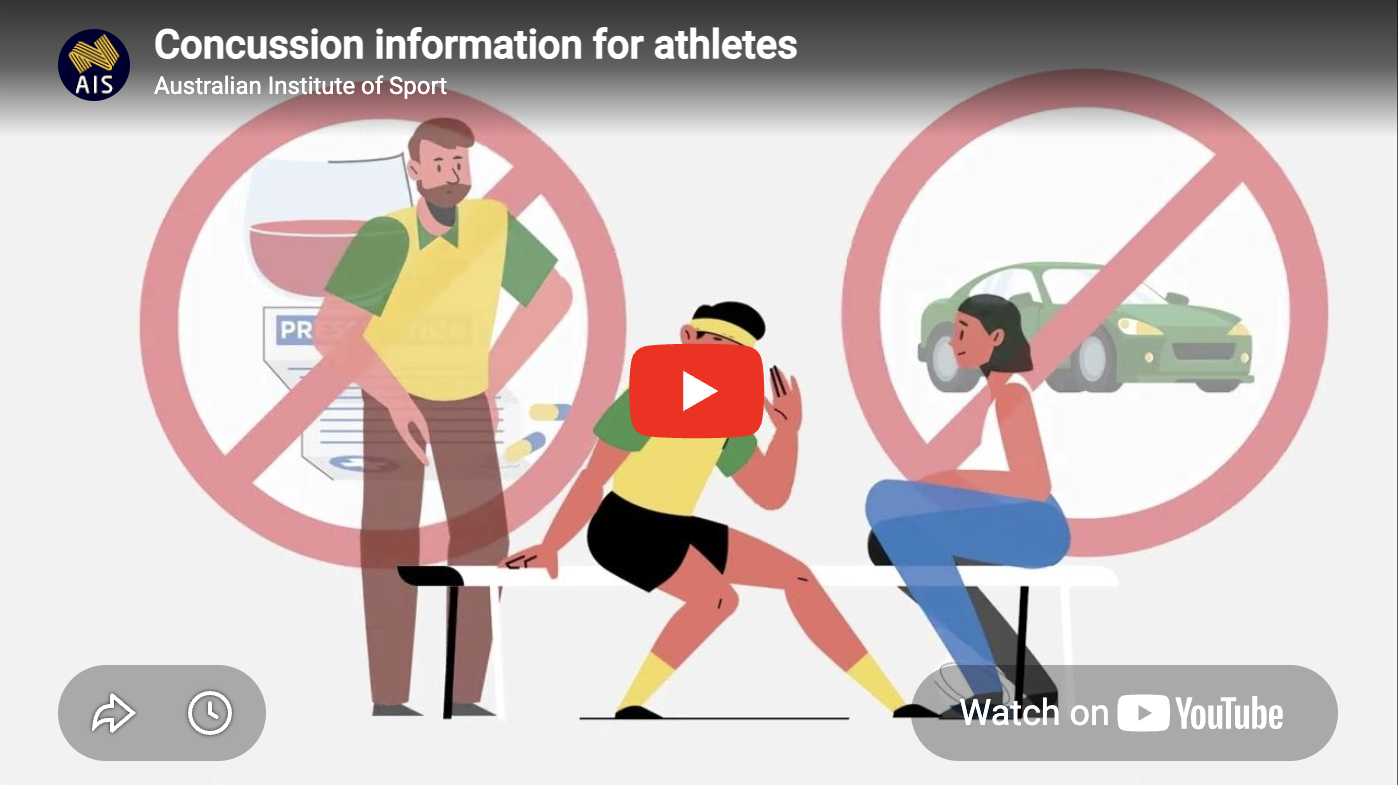
How to Manage Concussion
As per the AIS AUSPORT government website, any athlete with suspected or confirmed concussion should:
- remain in the company of a responsible adult
- not be allowed to drive
- be advised to avoid alcohol
- check their medications with their doctor.
Specifically, concussed athletes should avoid:
- aspirin
- anti-inflammatories (such as ibuprofen, diclofenac or naproxen),
- sleeping tablets
- sedating pain medications.
If diagnosed with concussion, athletes require immediate physical and mental rest; this allows the brain to recover.
To properly rest, time off school or work may be needed. Mental rest may include refraining from playing computer games, reading and watching television.
Children and adolescents
Children and adolescents aged 18 years or younger take longer to recover so a more conservative approach to concussion management should be taken. Concussive symptoms usually resolve in less than four weeks.
The child should be completely free of symptoms for at least 14-days before returning to contact or collision activities.
Return to learn
‘Return to learn’ is about the athlete’s gradual return to their usual program at school or work.
Having rested for 24 – 48 hours after sustaining a concussion, school-age athletes can return to school or study – as long as these activities don’t worsen symptoms. Thinking or concentrating for long periods can bring on or worsen symptoms of concussion. Gradually increasing the load on the brain without provoking symptoms is recommended.
School programs may need to be modified to include more regular breaks, rests and increased time to complete tasks. Exams during that period may need to be postponed.
Return to school and learning should take priority before returning to sport. A concussed child should not return to sport until they have successfully returned to normal school activities.
Return to sport
‘Return to sport’ is about the athlete’s gradual return to full sporting activity.
Having rested for 24 – 48 hours after sustaining a concussion, the athlete can begin light physical activity – as long as the activity doesn’t worsen symptoms. Once symptoms have cleared, the athlete can begin a staged return to sport.
These Graded Return to Sport Frameworks can be used to inform Return to Sport programs.
LINKS
- Headcheck App. Or download it from the App Store by clicking here.
- Concussion Recognition Tool (CRT).
- Sport Concussion Assessment Tool 6 (SCAT6).
- AFL Community Concussion Guidelines 2021.
TO BOOK
Dr Mark Benton, Sports Doctor, call Physiosports Brighton on 95969110 or book an appointment online by clicking here.
practitioners
Anthony is an APA SPORTS PHYSIOTHERAPIST who completed his Masters in Sports Physiotherapy at La Trobe University.
Since graduating in 2002 Anthony has worked in a variety of sports and clinical settings, working with multiple stage performances including 'Wicked' the musical. Anthony is currently the Head Physiotherapist at Hampton Rovers Football Club, while also managing Southern Saints netball and Parkdale Vultures Super Rules.
Anthony has a special interest in sporting injuries and injury prevention, in particular the pelvis, hip & groin, joint hypermobility and dance related injuries, including pre-pointe assessments.
Anthony uses his extensive experience to tailor individually specific approach to rehabilitation, self-management strategies and education, providing a pathway from acute injury to return to sport or function.